Discover how AI advisor technology is transforming decision making in 2025 Explore key benefits real world applications challenges and expert tips for success
By 2025, experts predict that over 70% of financial institutions and businesses will use an ai advisor to optimize decisions and drive growth. The rapid adoption of this technology is transforming how organizations and individuals approach problem-solving, improving efficiency and offering highly personalized experiences at scale.
Understanding what an ai advisor can do is now essential for professionals, companies, and consumers who want to remain competitive in a changing landscape. Being able to leverage these advanced tools will separate industry leaders from those left behind.
This article is your essential guide for mastering the ai advisor in 2025. We will break down what makes these systems unique, explain their evolution, explore practical applications, and discuss both the opportunities and challenges ahead.
You will learn how to integrate ai advisor solutions effectively, what risks to watch for, and what the future holds as this technology continues to evolve. Get ready to demystify ai advisors and gain the insights you need to thrive in the age of intelligent guidance.
AI advisors are rapidly transforming how professionals and organizations approach complex decision-making. In this section, we will explore what an ai advisor is, trace its evolution over the last decade, examine why it is crucial in 2025, and clarify how it compares to human advisors.
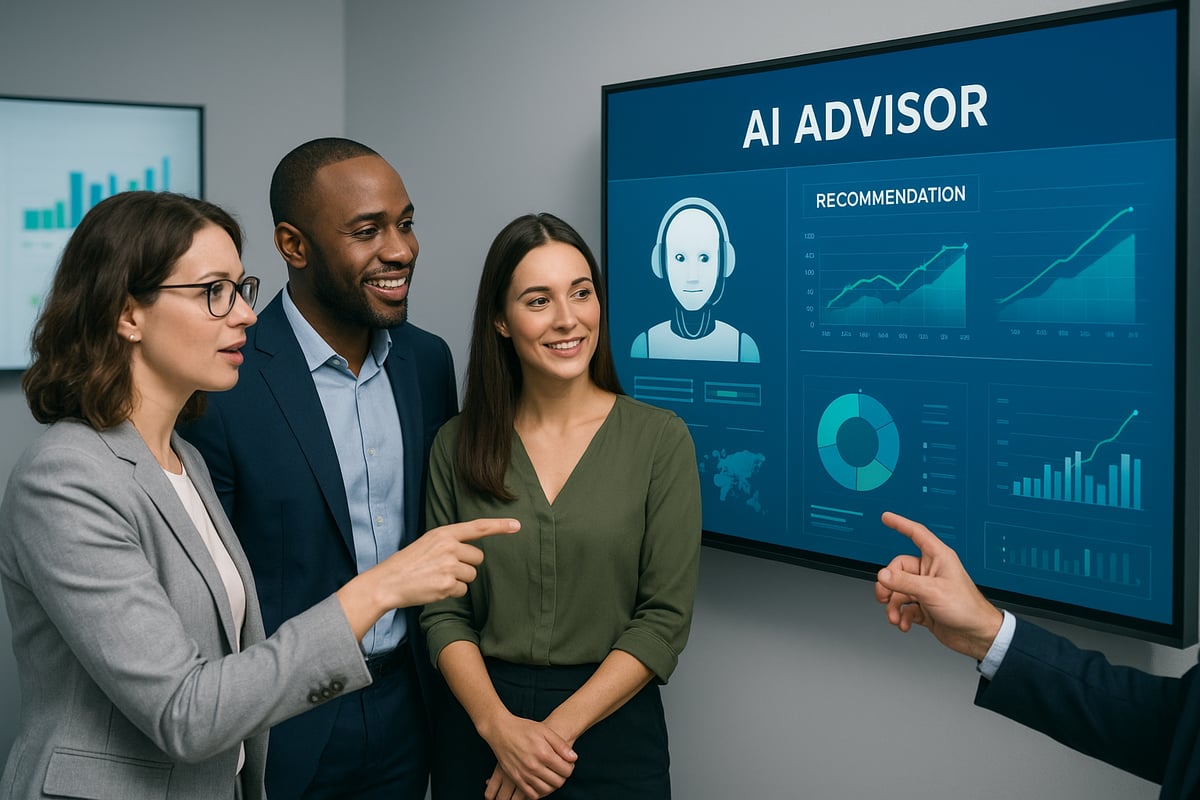
An ai advisor is an advanced artificial intelligence system designed to analyze data, provide personalized recommendations, and automate complex tasks. Unlike traditional digital assistants that simply follow commands or answer basic queries, an ai advisor leverages deep learning and contextual analysis to deliver tailored advice based on real-time information.
Core capabilities of an ai advisor include:
There are several types of ai advisor:
For example, in investment management, an ai advisor can continuously monitor market trends, rebalance portfolios, and suggest asset allocations that fit an investor's risk profile. This level of personalization and automation distinguishes ai advisor solutions from earlier digital tools.
The journey of the ai advisor began with simple rule-based chatbots in 2015, which could only perform predefined tasks. As artificial intelligence advanced, breakthroughs in natural language processing and deep learning enabled these systems to understand context, learn from vast datasets, and adapt to unique scenarios.
Key milestones include:
Early robo-advisors offered basic portfolio management, but by 2025, ai advisor platforms can analyze multiple data streams, anticipate user needs, and provide holistic guidance. For a deeper dive into this evolution and the roadmap for responsible AI-driven financial planning, see Robo-Advisors Beyond Automation: Principles and Roadmap for AI-Driven Financial Planning.
A comparison of early vs. modern AI advisors:
| Feature | Early Robo-Advisors | AI Advisors in 2025 |
|---|---|---|
| Decision-making | Rule-based | Context-aware |
| Personalization | Limited | Highly tailored |
| Data integration | Basic | Real-time, multi-source |
| Automation | Partial | End-to-end |
The significance of the ai advisor in 2025 cannot be overstated. The exponential growth of data and the increasing complexity of business environments demand solutions that can process information quickly and accurately. Professionals and consumers alike require real-time, personalized advice to stay ahead.
AI advisors greatly enhance user experiences by delivering instant insights, reducing errors, and improving efficiency. Businesses that deploy an ai advisor benefit from streamlined operations and more informed decisions. According to industry reports, the global market for AI advisor technology is projected to reach substantial value by 2025, reflecting widespread adoption.
In daily life, an ai advisor might help consumers optimize spending, manage health routines, or make travel plans with minimal effort. This widespread utility demonstrates why understanding and leveraging ai advisor technology is essential for staying competitive in today's fast-paced world.
While both human and ai advisor services aim to provide expert guidance, their approaches and capabilities differ in critical ways.
Key differences include:
Many organizations now adopt hybrid models, combining the analytical power of an ai advisor with the empathy and judgment of human professionals. This synergy maximizes both efficiency and personalized care, empowering teams to deliver exceptional results.
The rapid evolution of the ai advisor in 2025 is driven by cutting-edge technologies. These innovations enable smarter, faster, and more secure decision-making across industries. Let us explore the five essential technological pillars that make the modern ai advisor possible.

Machine learning and deep learning are the engines behind the ai advisor’s ability to recognize patterns and predict outcomes. These algorithms process vast amounts of structured and unstructured data, identifying trends that may be invisible to human analysts.
For example, an ai advisor in finance uses deep learning models to detect subtle anomalies in transaction data, uncovering potential fraud before it escalates. These systems continuously learn and adapt, improving their accuracy over time.
The integration of machine learning is so significant that 77% of Bank Advisors Plan to Incorporate AI into Their Practice, reflecting the widespread trust in these technologies to enhance advisory services.
Natural language processing and generation empower the ai advisor to understand, interpret, and respond to human language. NLP allows these systems to analyze text, voice, and even sentiment, creating seamless conversations with users.
For instance, an ai advisor in financial planning can interpret client queries, analyze their financial goals, and generate personalized recommendations in plain language. With NLG, the advisor can create detailed reports, summaries, or insights tailored to individual preferences.
This conversational capability not only streamlines interactions but also increases client engagement and satisfaction, making complex information accessible to all.
Knowledge graphs form the backbone of contextual understanding for the ai advisor. By mapping relationships between data points, these graphs help the system comprehend the bigger picture and offer advice that considers all relevant factors.
In healthcare, for example, an ai advisor leverages knowledge graphs to connect symptoms, patient history, and treatment options. This enables the advisor to suggest the most suitable interventions based on a holistic view.
Contextual reasoning ensures that recommendations are both accurate and relevant, enhancing the value delivered to end users.
Robust data security and privacy measures are critical for any ai advisor, especially in sectors like finance and healthcare. Encryption, data anonymization, and compliance with regulations such as GDPR and CCPA protect sensitive information and maintain trust.
A recent industry statistic reveals that a significant percentage of ai advisor platforms now incorporate advanced encryption technologies. This widespread adoption demonstrates a strong commitment to safeguarding user data and adhering to evolving regulatory standards.
As the ai advisor processes large volumes of confidential data, these security protocols are non-negotiable for responsible deployment.
Cloud and edge computing have revolutionized the scalability and responsiveness of the ai advisor. Cloud platforms enable vast data storage and real-time analytics, while edge computing brings processing closer to data sources for faster insights.
Consider an ai advisor managing a global supply chain. By integrating with cloud databases and edge devices, it can monitor inventory, predict disruptions, and optimize logistics in real time.
This combination supports the ai advisor’s ability to deliver timely, actionable advice, even in complex and dynamic environments.
The adoption of ai advisor solutions is accelerating across major industries, transforming how organizations deliver value and streamline operations. From finance to education, ai advisor technology is setting new standards for efficiency, decision-making, and personalization.

In financial services, the ai advisor is redefining portfolio management, retirement planning, and risk assessment. These platforms analyze market data, client preferences, and risk profiles to create optimized investment strategies.
A major benefit is real-time portfolio adjustment. For example, an ai advisor can automatically rebalance assets in response to market volatility, often outperforming traditional portfolios. According to industry reports, adoption of ai advisor tools among financial institutions is projected to exceed 70% by 2025.
The rise of generative AI is further enhancing productivity and efficiency, as highlighted in the Generative AI Use Surges Among Financial Advisors report. Advisors are leveraging these tools to deliver deeper insights and highly personalized recommendations.
The ai advisor is revolutionizing healthcare by supporting diagnosis, recommending treatments, and enhancing patient engagement. By analyzing patient records, genetic data, and clinical studies, ai advisor systems help clinicians make more informed decisions.
For instance, hospitals have deployed ai advisor platforms that monitor patient data in real time, flagging early signs of complications. This proactive approach has led to significant reductions in hospital readmissions. The healthcare ai advisor market is growing rapidly, with investments expected to reach new highs in the coming years.
Patients also benefit from personalized wellness plans and 24/7 virtual consultations, improving outcomes and satisfaction.
Executives and managers are turning to ai advisor solutions for business intelligence and decision support. These systems digest vast datasets, uncover trends, and generate actionable insights.
Key applications include sales forecasting, supply chain optimization, and workforce planning. For example, an ai advisor can analyze historical sales data and external economic indicators to produce more accurate quarterly projections.
This technology empowers leaders to make data-driven decisions, reduce uncertainty, and respond quickly to market changes. As a result, businesses report measurable improvements in operational efficiency and profitability.
Customer service is experiencing a transformation with the ai advisor acting as a virtual agent. These platforms handle inquiries, resolve issues, and even upsell products—all with 24/7 availability and support in multiple languages.
A standout advantage is the reduction in customer wait times. For instance, companies deploying ai advisor chatbots have seen up to a 60% decrease in call center queues. Customers receive faster, more accurate responses, leading to higher satisfaction rates.
Additionally, ai advisor systems can analyze customer sentiment, enabling businesses to tailor their approach and build stronger relationships.
In education, the ai advisor delivers adaptive learning experiences and real-time feedback. These platforms assess student progress, identify learning gaps, and recommend personalized study paths.
For example, an ai advisor can suggest targeted exercises based on a student's performance, resulting in improved outcomes. Schools and EdTech companies report that ai advisor technology increases student engagement and retention.
The market for AI-powered EdTech platforms is expanding rapidly, reflecting the growing demand for individualized learning and support.
Adopting an ai advisor can transform how your organization operates, but success depends on a strategic, stepwise approach. This guide breaks down each phase, from defining your needs to ensuring smooth adoption, so you can maximize value and stay ahead in 2025.

Begin your ai advisor journey by identifying the specific business processes or decision areas that require enhancement. Are you looking to reduce manual workloads, improve customer engagement, or gain deeper insights from data?
Set clear, measurable objectives. For instance, if your goal is to accelerate customer onboarding, define a target reduction in processing time. Outline existing challenges and desired outcomes to ensure alignment among stakeholders.
Involve key departments early, as their insights will shape the scope and expectations for your ai advisor implementation.
Next, compare available ai advisor platforms based on scalability, integration capabilities, customization, and regulatory compliance. Use a decision matrix to weigh each solution’s strengths and weaknesses.
| Criteria | Platform A | Platform B | Platform C |
|---|---|---|---|
| Scalability | High | Medium | High |
| Integration | Yes | Limited | Yes |
| Customization | Extensive | Moderate | Extensive |
| Compliance | Strong | Weak | Strong |
Stay informed about industry trends and advisor perspectives by consulting resources like Schwab's 2025 Independent Advisor Outlook Study: Trust, Talent and Technology Shaping the Next Era of Independent Advice.
Select a platform that aligns with your business needs, technical infrastructure, and future growth plans.
Success with an ai advisor depends on high-quality data. Begin by collecting, cleaning, and structuring your data to ensure accuracy and relevance.
Prioritize data privacy and compliance from the start. For example, when integrating CRM data for personalized recommendations, use secure APIs and anonymize sensitive fields.
# Sample data anonymization
import pandas as pd
df = pd.read_csv('customer_data.csv')
df['Name'] = 'REDACTED'
df.to_csv('anonymized_data.csv', index=False)
Integrate your data sources to give the ai advisor a comprehensive view of your business environment.
Tailor the ai advisor to fit your unique requirements. Customize workflows, decision logic, and user interfaces to reflect your industry’s standards and internal processes.
Train the ai advisor using proprietary data sets. This ensures it understands context-specific nuances, such as compliance with local regulations or industry terminology.
For industries like finance or healthcare, adjust the advisor’s algorithms to follow sector-specific rules. This targeted approach drives more accurate, actionable recommendations.
Before full deployment, conduct pilot programs to validate your ai advisor’s performance. Gather feedback from real users, monitor key metrics, and identify any biases or errors in its recommendations.
A/B testing is especially effective. For example, compare outcomes between users guided by the ai advisor and those using traditional methods.
Address issues promptly, refining the system based on insights. This phase ensures your ai advisor delivers reliable, unbiased value from day one.
Roll out your ai advisor with a clear change management strategy. Offer comprehensive training sessions to staff, covering both technical use and best practices for human-AI collaboration.
Communicate the benefits and address concerns proactively. Use support resources to help users adapt and encourage feedback for ongoing improvement.
Monitor adoption rates and user satisfaction. With effective change management, your ai advisor becomes an integrated, trusted asset across your organization.
The widespread adoption of ai advisor technology brings significant promise, but it also introduces complex challenges across privacy, ethics, and regulation. Addressing these risks is essential for organizations and users to build trust and maximize the benefits of ai advisor systems.
Data privacy is a top concern for any ai advisor platform. These systems process sensitive personal and business information, making them attractive targets for cyberattacks. A single breach can expose massive datasets and erode user trust.
Organizations must enforce robust encryption, access controls, and regular security audits to protect data handled by an ai advisor. Compliance with frameworks like GDPR and CCPA is mandatory, especially in finance and healthcare.
Despite best efforts, high-profile breaches have occurred, highlighting the importance of vigilance when deploying an ai advisor.
Algorithmic bias is a persistent risk in ai advisor systems. If training data contains hidden prejudices, the ai advisor may unintentionally reinforce discrimination or unfair outcomes. This can affect hiring, lending, or healthcare decisions.
Explainable AI models are crucial. They enable users to understand how an ai advisor reaches its recommendations. Transparency helps build confidence and allows organizations to identify and address bias early.
A recent survey found that over 60% of users express concerns about AI fairness. For further reading, the AI Now Institute offers resources on algorithmic transparency.
The rise of ai advisor tools is changing workforce dynamics. While automation can take over repetitive tasks, it also creates opportunities for collaboration and new roles. Hybrid teams, where humans and ai advisor systems work together, are becoming the norm.
Reskilling and upskilling programs help employees adapt to these changes. Rather than replacing jobs outright, an ai advisor can augment human expertise and free up time for strategic work.
Organizations embracing human-AI collaboration see productivity gains and improved decision quality.
Users expect an ai advisor to deliver accurate and reliable guidance. However, errors and unexpected outcomes can occur, sometimes with serious consequences. Defining accountability is critical, especially when an ai advisor makes high-stakes decisions.
To build trust, organizations should track performance metrics and establish protocols for handling mistakes. This includes clear escalation paths when users need human intervention.
A notable incident involved an ai advisor making a financial error, resulting in significant losses. Prompt human oversight is key to preventing such situations.
The legal landscape for ai advisor deployment is evolving rapidly. New laws are emerging to address AI use, liability, and consumer protection. Industries like finance face strict rules, such as updated SEC guidelines for automated advice.
Staying compliant requires ongoing monitoring of regulations and adapting ai advisor systems to meet new standards. Documentation, audit trails, and legal reviews are essential.
As regulations tighten, organizations must ensure their ai advisor platforms operate within legal boundaries to avoid penalties and reputational harm.
The landscape for ai advisor technology is rapidly evolving, with new trends shaping the future of business and personal decision-making. As we look ahead to 2025 and beyond, understanding these trends will be essential for those wanting to harness the full power of ai advisor solutions. Let us explore the major directions that will define the next era of intelligent advisory systems.
By 2025, ai advisor platforms will deliver hyper-personalized guidance, using real-time data to adapt to each user’s unique needs. This evolution is driven by advances in machine learning and contextual reasoning, enabling ai advisor systems to anticipate preferences, behaviors, and life events.
Imagine an ai advisor that not only tracks your financial goals but also adjusts strategies when you change jobs or experience major life milestones. Contextual awareness allows these systems to provide recommendations that feel remarkably tailored and timely.
For example, an ai advisor in wealth management could proactively suggest shifting investments when it detects changes in market sentiment or personal circumstances. This level of personalization will set a new standard for user experience across industries.
A defining trend for ai advisor solutions is their growing autonomy. Instead of waiting for user prompts, tomorrow’s ai advisor will proactively analyze data, identify opportunities, and make recommendations without constant oversight.
Self-learning algorithms will enable the ai advisor to refine its advice continuously. For instance, in financial services, an ai advisor can monitor market fluctuations and automatically rebalance portfolios for optimal performance.
The increased autonomy means businesses and individuals can rely on their ai advisor for faster, more accurate decisions. This shift frees up human experts to focus on strategy and complex problem-solving, while the ai advisor manages routine or time-sensitive choices.
Ai advisor platforms in 2025 will integrate seamlessly with emerging technologies, expanding their capabilities and applications. By connecting with IoT devices, blockchain networks, and augmented or virtual reality systems, the ai advisor can access richer data and deliver deeper insights.
For example, a healthcare ai advisor might use data from wearable devices and medical sensors to offer real-time health advice, while blockchain integration ensures data integrity and security.
In the manufacturing sector, an ai advisor could leverage IoT sensor data to optimize supply chains, reducing delays and costs. This convergence of technologies will redefine what an ai advisor can achieve for organizations and consumers alike.
The democratization of ai advisor solutions will be a major force by 2025. As technology becomes more affordable and user-friendly, access to expert-level advice will no longer be limited to large corporations or wealthy individuals.
Small businesses and everyday consumers will benefit from ai advisor tools that were once out of reach. According to industry forecasts, the global user base for ai advisor technologies is projected to grow significantly by 2030, reflecting this shift toward inclusivity.
To learn more about the expanding impact of AI across industries, see this McKinsey report on AI adoption. The ai advisor revolution promises to level the playing field, making expert advice accessible to all.
As ai advisor systems become more prevalent, ethical and social considerations will move to the forefront. Society will need to establish clear guidelines for transparency, accountability, and responsible use of ai advisor technology.
Industry leaders are already developing ethical frameworks to address issues like bias, data privacy, and the role of human oversight in ai advisor decision-making. These efforts aim to build trust and ensure that innovation aligns with societal values.
Initiatives focused on ethical standards will influence how ai advisor solutions are designed and deployed. The ongoing dialogue between technologists, regulators, and users will shape the future of responsible AI advisory services.
As we’ve explored, AI advisors are quickly reshaping how decisions are made—bringing new possibilities for personalized retirement planning and financial security, especially for Fort Worth’s Lockheed Martin community. If you’re curious about how these innovations could fit into your own retirement strategy or want to ensure your plan keeps up with tomorrow’s technology, I encourage you to take the next step. Let’s discuss your unique needs and see how a precision-engineered approach can work for you. You can Schedule a Free Consultation to get started with confidence and clarity.
.png)